
Boosting independent careers in science.

2026 Boehringer Ingelheim Prize
Dr Julian Wagner receives the main prize for research on heart ageing
At the festive award ceremony of the Boehringer Ingelheim Prize on
30 June 2026, the Boehringer Ingelheim Stiftung awarded the main prize to
Dr Julian Wagner from Goethe University Frankfurt am Main. In addition to a personal prize of 5,000 EUR, Dr Wagner received 55,000 EUR in research funding to realize an innovative research project and to help him sharpen his scientific profile.
Following the motto "Connecting Science and People", the event brought together researchers and interested guests from across the Rhine-Main region at the Boehringer Ingelheim campus. In addition to honouring the outstanding achievements of the prize winner and the finalists, it provided an opportunity for scientific exchange and networking. The evening was accompanied by music from the Kleiner, Meisenzahl & Höhn Jazzgroove Trio, and the programme was hosted by Desiree Hoving.
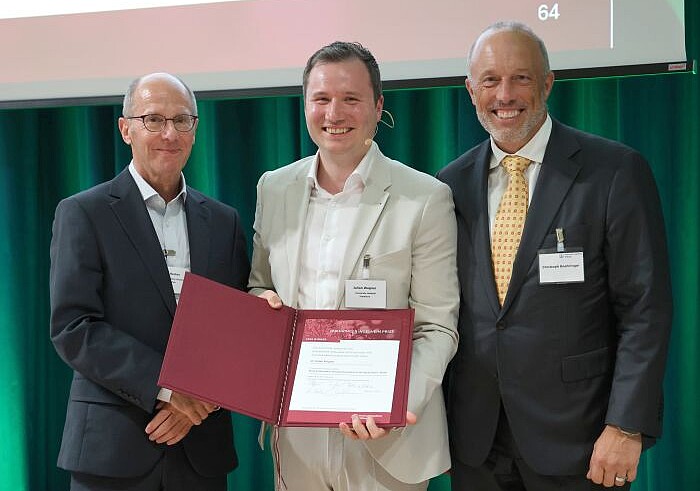
(from left to right): Prof. em. Dr Peter B. Becker (Acting Chair of the Selection Committee), Dr Julian Wagner, Christoph Boehringer (Chair of the Executive Committee of the Boehringer Ingelheim Stiftung). Photo: Boehringer Ingelheim
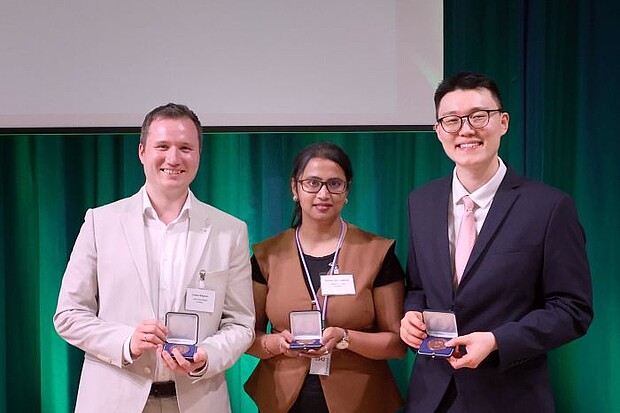
Three finalists – three outstanding research profiles
The three finalists of the 2026 Boehringer Ingelheim Prize exemplify different pathways of successful biomedical research:
Dr Taniya Chakraborty combines biology, chemistry and physics to investigate fundamental questions in synthetic biology and to develop new approaches for artificial cellular systems.
Josef Shin, MD PhD, as a clinician scientist, brings questions from neurology – in particular multiple sclerosis – directly into experimental basic research, thereby bridging patient care and the laboratory.
Dr Julian Wagner investigates the molecular basis of heart ageing and develops new approaches to better understand age-related changes in the cardiovascular system.
All three are characterised by scientific excellence, originality and exceptional future potential. Further information on the finalists of the 2026 Boehringer Ingelheim Prize can be found in the corresponding press release.
Keynote: RNA design for synthetic cells
Following the finalists' presentations, Professor Dr Kerstin Göpfrich delivered the keynote lecture “RNA Design: Structures for Synthetic Cells”. She is Professor of Biophysical Engineering of Life at the Center for Molecular Biology of Heidelberg University (ZMBH).
In her talk, she showed how RNA molecules can be deliberately designed so that they can serve as building blocks for artificial, cell-like systems. In the long term, such approaches could help to construct simplified artificial cell models in the laboratory, opening up new perspectives for basic life science research as well as for potential applications in medicine. At the same time, they contribute to addressing fundamental questions about what constitutes a minimal living cell.
Main prize for Dr Julian Wagner
After the presentations, the independent selection committee announced its decision and awarded Dr Julian Wagner the main prize of the 2026 Boehringer Ingelheim Prize.
The decision was based on the strong coherence of his scientific profile. His previous work combines outstanding individual research achievements with an excellent publication record and a compelling scientific vision. In his award-winning publication, Dr Wagner identified the protein ZBTB16 as a key molecular protective factor against heart ageing. This revealed a previously unknown mechanism that opens new perspectives for the treatment of age-related cardiovascular diseases. With the newly awarded research funding, Dr Wagner will continue this line of research. His research project investigates the interplay between ageing processes, regulation by the nervous system, and the function of the atria – an area that remains poorly understood despite its high clinical relevance, particularly for the development of atrial fibrillation. He combines state-of-the-art cellular models based on induced pluripotent stem cells, animal models, and data from human tissue in an integrative research approach.
The selection committee particularly highlighted the scientific depth, methodological breadth, and high innovative potential of the project. The work opens new perspectives for understanding heart ageing and could, in the long term, pave the way for novel therapeutic strategies.
Original publication: Stilz KA, Leonard VE, Rodriguez Morales D, Glaser S, Larcher V, Ruz Jurado M, Malacarne PF, Manickam N, Tombor LS, Abplanalp WT, Panthel J, Kujundzic H, Fischer A, Schmitz K, Mueller OJ, Hille S, Kupatt C, Bozoglu T, Sami H, Ogris M, Procida-Kowalski T, Bartkuhn M, John D, Yekelchyk M, Schmachtel T, Rieger MA, Pham M, Krishnan JA, Guenther S, Brandes RP, Braun T, Zeiher AZ, Wagner JUG#, Dimmeler S#. Endothelial ZBTB16: a molecular shield against cardiac aging. European Heart Journal 2026, ehaf1063. doi: 10.1093/eurheartj/ehaf1063.
The Finalists
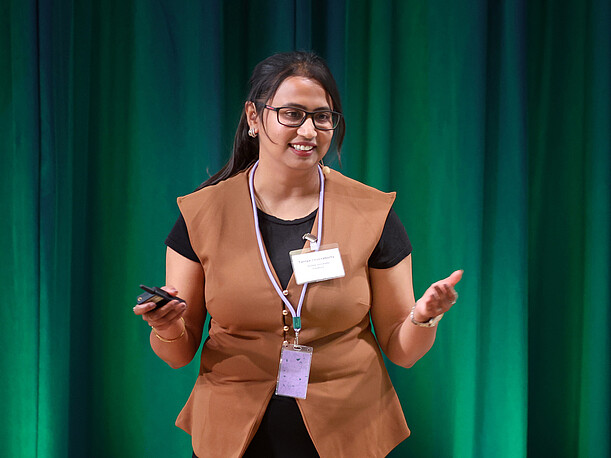
Photo: Boehringer Ingelheim
Taniya Chakraborty – RNA origami cytoskeletons for synthetic cells
Dr Taniya Chakraborty has been leading a junior research group at the Faculty of Biochemistry, Chemistry and Pharmacy of Goethe University Frankfurt since March 2025. She receives the finalist prize for her work in bottom-up synthetic biology. In her postdoc research, she used RNA origami – the controlled folding of RNA molecules with defined sequences – to generate structures that can serve as building blocks for an artificial cytoskeleton in synthetic cells. To achieve this, she introduced individual DNA molecules into membrane-enclosed lipid vesicles in a test tube, together with a minimal protein machinery for transcribing DNA into RNA. Depending on the DNA sequence, the RNA molecules formed straight or curved RNA origami filaments as well as ring-shaped structures while being transcribed. Her work demonstrates that RNA origami is a powerful technology for recreating complex cellular components – an important step towards a fully autonomous synthetic cell.
Original publication: Tran, M. P.*, Chakraborty, T.*, Poppleton, E., Monari, L., Illig, M., Giessler, F., Göpfrich, K. Genetic encoding and expression of RNA origami cytoskeletons in synthetic cells. Nature Nanotechnology 2025, 20: 664–671.
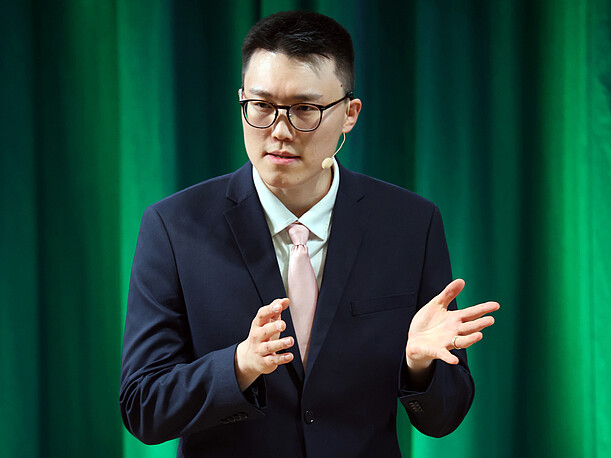
Photo: Boehringer Ingelheim
Josef Shin – B cell-driven nerve cell damage and its reversal in multiple sclerosis
Josef Shin, MD PhD, is a resident physician and neuroscientist at the Department of Neurology at the University Medical Center Mainz. His research focuses on how immune cells and nerve cells interact to understand how autoimmune diseases of the nervous system – such as multiple sclerosis (MS) – arise and can be treated. He discovered a direct link between the chronic activation of B lymphocytes – a hallmark of MS – and the damage to nerve cells. Chronically activated B cells release a signalling molecule called lymphotoxin-alpha (LTα), which triggers a chain of reactions that first disrupts the transmission of signals along nerve cells and ultimately leads to their death. When Josef Shin blocked this LTα-induced signalling cascade using a known inhibitor of the protein BTK, the nerve cells recovered. The BTK inhibitor used is already known to have beneficial effects on the clinical course of MS in patients. Josef Shin's work reveals a likely mechanism underlying this clinical effect and points to new therapeutic strategies to protect nerve cells and treat MS more effectively.
Original publication: Shin J*, Götz P*, Sharif N, Sola-Sevilla N, Grasmuck C, Schraad M, Pape K, Muthuraman M, Fleischer V, Zandee SE, Bittner S, Vogelaar CF, Prat A, Hanuscheck N, Zipp F. Bruton’s tyrosine kinase inhibitors rescue neuronal impairment caused by B cell–mediated lymphotoxin-α release. Science Translational Medicine 2025, 17(822). doi: 10.1126/scitranslmed.adx2652.